


How to Compare Deck Staining Contractors in Milton
Deck staining proposals can look similar while describing very different work. One may include only a light clean and a new coat; another may include coating identification, repairs, stripping or sanding, plant protection, weather hold points and a documented handoff. The fairest comparison begins with one deck-condition brief and asks every contractor to explain how the proposed system addresses it.
Home Painter Services lists deck and fence staining within its services route and publishes a separate deck staining guide. Those pages establish topic relevance, not the credentials, insurance, products, schedule or warranty for a future project.
Compare contractor models by fit rather than label
A painting contractor with exterior-wood services may coordinate preparation and coating within a broader painting operation. A deck-restoration specialist may focus on stripping, sanding and finish correction. A general property-maintenance provider may be appropriate for a sound deck needing limited maintenance. A carpenter paired with a coating contractor may fit decks with structural or board-replacement concerns. The business label does not prove the scope.
| Provider approach | Potential fit | Trade-off to investigate | Evidence request |
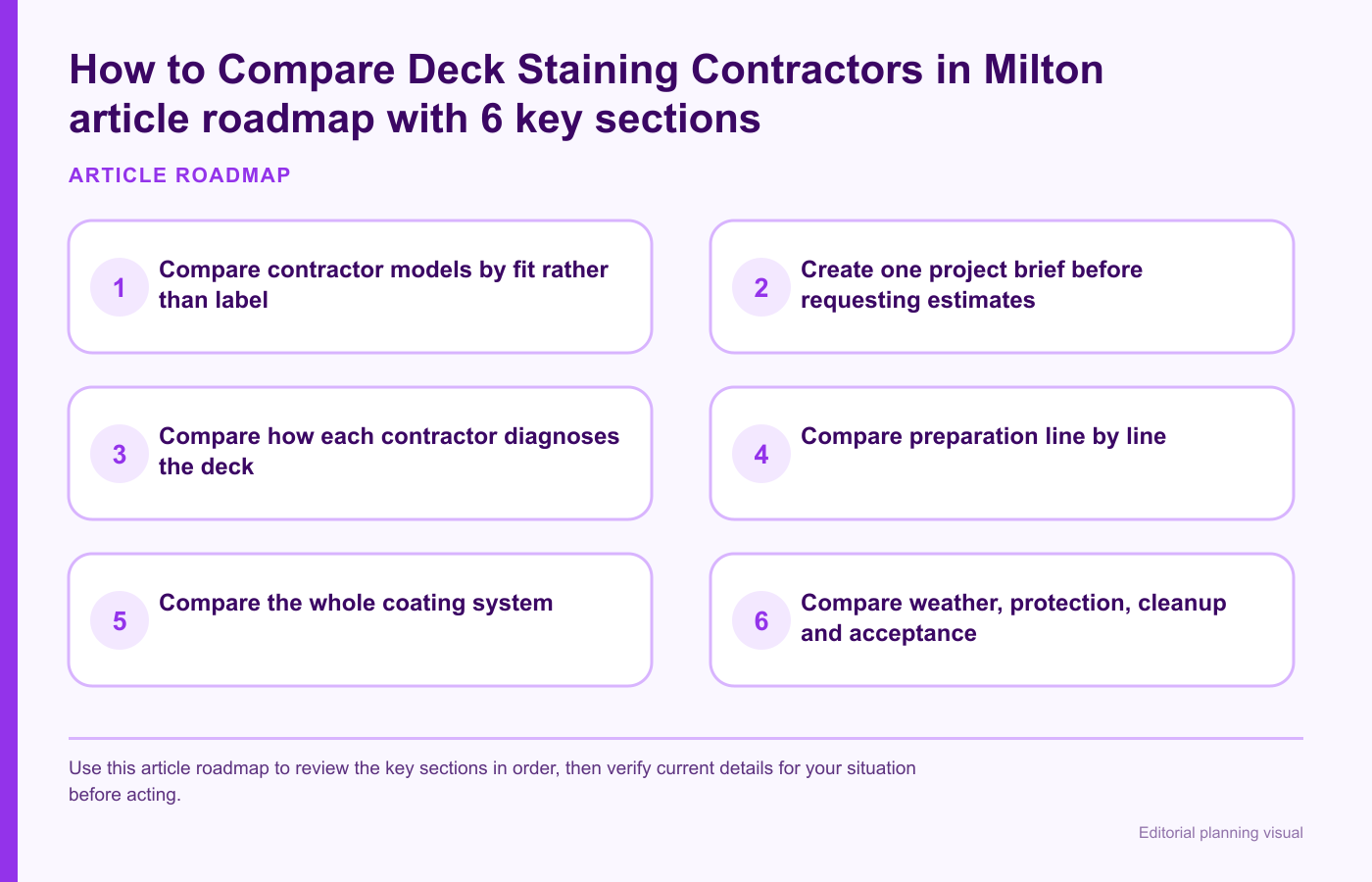
|---|---|---|---|
| Painting contractor | Coating-led project with coordinated exterior protection | Depth of wood-restoration and repair scope | Written deck process and comparable references |
| Deck restoration specialist | Failed finish or intensive preparation | Whether structural repairs are included | Removal method, dust and damage controls |
| Maintenance provider | Limited clean-and-refresh scope on suitable wood | Whether existing coating and moisture are assessed | Inspection record and product compatibility |
| Carpenter plus coater | Loose, damaged or altered deck components | Responsibility between trades | Repair and coating handoff matrix |
Use the same questions for every option. A more specialized provider is not automatically better, and a broader provider is not automatically less capable. The right fit is the one whose verified scope matches the deck’s actual condition.
Create one project brief before requesting estimates
Photograph boards, railings, stairs, undersides, transitions and surrounding landscaping. Record known age, wood type if known, prior coating and previous work without guessing. Note peeling, dark growth, grey fibres, splinters, cupping, soft areas, loose fasteners, movement, standing water and failed joints. Identify furniture, screens, pools, gardens, neighbouring surfaces and access constraints.
- Define which surfaces are included and excluded.
- State the desired appearance without naming a product prematurely.
- List damage that may require a carpenter or other specialist.
- Identify pets, children, access routes and no-work periods.
- Ask each contractor to visit the same conditions.
- Request separately priced options only when scope differs.
This brief prevents one proposal from pricing the floor only while another includes rails, stairs, skirting and furniture handling. It also exposes assumptions early.
Compare how each contractor diagnoses the deck
A useful inspection distinguishes coating failure from wood damage and cosmetic wear from safety concerns. Ask how the contractor identifies the existing finish, evaluates adhesion, checks moisture readiness, finds decay or movement, and decides whether cleaning, abrasion, stripping, repair or replacement is required. A visual glance cannot answer every question.
| Inspection item | Question | Decision it informs |
|---|---|---|
| Existing coating | What is known and what compatibility test will be used? | Clean, abrade, strip or test area |
| Wood condition | Which boards or components need specialist repair? | Repair boundary before coating |
| Moisture and drainage | How will readiness and trapped-water risks be assessed? | Weather and application gate |
| Contamination | What growth, dirt, grease or residue is present? | Cleaner, rinse and containment plan |
| Exposure | Where are sun, shade and heavy traffic concentrated? | Appearance and maintenance expectations |
If the deck has significant movement, soft wood, questionable guards or stairs, coating work should pause until the appropriate qualified person evaluates the condition. Stain does not repair a structural problem.
Compare preparation line by line
Preparation should be connected to the current surface and the selected manufacturer’s instructions. Compare cleaning method, chemical use, rinse and runoff control, drying, coating removal, sanding, dust collection, fastener work, board replacement, masking and final cleanliness. “Power wash and stain” is not enough detail to compare.
High pressure can damage wood fibres, while inadequate cleaning can leave contamination. Sanding may smooth raised grain or remove failing material but can also change absorption if uneven. Stripping adds chemical, runoff and residue questions. Ask for a small test area when appearance or compatibility is uncertain, and approve the result in realistic lighting.
Compare the whole coating system
Transparent, semi-transparent and solid-colour finishes create different appearance and maintenance paths. Water-borne and oil-modified systems can have different preparation, application and cleanup instructions. The existing coating, wood, exposure and desired look constrain the choice. Ask for the exact product data and label instructions for the proposed system before approval.
Compare colour-test process, number of coats only as specified for that product and substrate, application method, end grain and vertical surfaces, mixing, wet-edge control and recoat rules. More coats are not automatically better; excessive material can fail when a penetrating product is not meant to build a film. The current manufacturer document controls.
Compare weather, protection, cleanup and acceptance
The proposal should state how temperature, rain risk, direct sun, wind and surface moisture affect start, pause and restart decisions. It should also cover plants, siding, masonry, windows, neighbours, drains and public areas. Ask who moves furniture, controls dust and rinse, stores materials and prevents access during application and curing.
| Control | Written question | Closeout evidence |
|---|---|---|
| Weather | Which manufacturer limits stop the work? | Recorded conditions and revised schedule |
| Protection | Which adjacent surfaces and plants are covered? | Pre-work condition photos |
| Access | When may people, pets and furniture return? | Product-specific written instruction |
| Cleanup | Who removes masking, residue, dust and waste? | Walkthrough checklist |
| Acceptance | How are colour, coverage and defects reviewed? | Signed punch list and care notes |
Verify the contractor and comparable experience
Ontario consumer guidance recommends defining the work, seeking multiple written estimates, checking references for similar work and confirming applicable workplace coverage or trade credentials. Ask for the legal business name, address, contact information, liability insurance evidence, WSIB status or applicable exception, subcontractor roles and references whose decks had similar coatings and condition. Verify documents with the issuing source where possible.
Review recent and older examples because appearance on completion does not show how a finish aged. Obtain permission before contacting references and ask what scope was actually completed. Online ratings can support research but do not replace documents, a site-specific scope or a contract.
Normalize estimates and contract terms
Put proposals into one matrix. Include measured surfaces, preparation, repairs, coating manufacturer and product, colour, application, protection, cleanup, schedule assumptions, taxes, payment, change procedure, warranty terms and exclusions. Ontario’s consumer guidance explains that written renovation contracts should identify the parties, project, materials, cost, payment, schedule, warranties, cleanup and subcontracting.
- Remove options that do not inspect the deck or explain preparation.
- Clarify every allowance, assumption and owner responsibility.
- Compare totals only after the scope matches.
- Require written approval for additional or changed work.
- Keep receipts, product information, colour codes and care instructions.
- Do not pay the full amount before the agreed completion and closeout process.
Common deck contractor comparison mistakes
- Choosing the lowest total: the least complete scope may create the lowest number.
- Skipping coating identification: compatibility and removal cannot be assumed.
- Accepting generic preparation: connect every step to observed conditions.
- Ignoring carpentry boundaries: clarify who handles damaged or moving components.
- Comparing coat counts: follow product-specific instructions.
- Trusting a colour chip: test on representative prepared wood.
- Leaving weather decisions verbal: define stop and restart rules.
- Assuming credentials or coverage: verify what applies to the business and work.
Frequently asked questions
Should every contractor recommend the same preparation?
No. Differences may reflect diagnosis, but each provider should explain the observed condition, proposed steps and manufacturer requirements.
Is a solid stain always better for an older deck?
No. Existing finish, wood condition, desired look and compatibility matter. Review an exact product system and test area.
Can staining fix soft or loose deck components?
No. Coatings do not correct structural decay or movement. Pause and obtain the appropriate assessment and repair scope.
What makes estimates comparable?
The same surfaces, preparation, repairs, products, protection, cleanup, schedule assumptions and closeout terms.
Build a one-page contractor scorecard
Weight diagnosis, preparation, coating evidence, protection, verification, contract clarity and communication. Record missing information as missing rather than guessing. The chosen provider should be able to explain the deck from current condition to maintenance handoff.
Sources reviewed
- Ontario home renovation consumer guidance — contractor research, estimates and contracts.
- Ontario contractor contract guide — written scope and estimate context.
- USDA Wood Handbook — exterior wood, weathering, moisture and finish context.
